9/24/2015: Morning Run, 5.2 Miles: Pacing Yourself in Training and Races

After hitting the gym on Tuesday for the first time in two weeks and completing my leg circuit, and then completing an intense 8.5 mile November Project NYC workout yesterday, I woke up sore. I usually recover quickly, but Tuesday’s gym workout really zonked my muscles.

So, what happens when we’re scheduled to run but we’re sore? We run! But we modify the run. I foam-rolled for a couple extra minutes before and after the run, cut my usual 6.2 mile route short by a mile, and ran at an easy pace. While most of my training happens in an aerobic heart rate zone between 134-144/145 beats per minute, this morning’s run barely cracked 135 beats per minute.

I ran instead of resting because I’m running the Bronx 10 Miler on Sunday, and wanted  two solid rest days instead of a rest day today followed by a Friday run followed by rest on Saturday. I believe two days with Time OFF My Feet will have me ready for the 10 Miler.

Unsurprisingly, this morning’s run highlighted my competitive nature. While I try to live by the statement, “You don’t win at training, but you can lose by overtraining,” I can still try to outrun other runners during training runs. This morning, therefore, while running at a reduced pace, I found myself pushing harder when runners passed me. I had to remind myself to run my own pace, and to keep my stride easy and effortless.

Keeping the focus on my pace has helped me during races as well. For example, when I ran the NYRR 10k Spring Meltdown in March, I followed a very specific race plan: Run miles 1-2 about 10 seconds slower than goal pace; run miles 3-4 at goal pace; and run miles 5-6.2 at  about 10 seconds faster than goal pace, focusing on passing runners only during these final 2.2 miles. I remember three or four guys barreling past me around miles 1.5-3, at which time I had to remind myself to focus only on my race. When I finally increased my pace at mile 5, I passed all of these runners. I finished in 39:47, my first sub-40 minute 10k, good enough for 33rd place out of 1,878 finishers.

I employed a similar strategy when I ran the Percy Sutton 5k in August, although I abbreviated the pacing strategy: Run the first mile about 5 seconds slower than goal pace, the second mile at goal pace, and go crazy on the final 1.1 miles. Again, I remember numerous runners skipping past me during miles 1-2. When I turned up the heat during mile 3, I cruised past most of these runners, and never saw them again. As I’ve posted about before, this performance snagged a 75th place finish out of 4,727 runners.

While these examples demonstrate good race strategy, I would be lying if I said that I’ve always paced well. For example, when I ran my second marathon, the 2004 Marine Corps Marathon in Washington, DC, I completely hosed the pacing. I was undertrained and overconfident, having completed my first marathon earlier that year with a negative split. I cruised through the first half at a pace much faster than I could ever sustain at that point in my running career. By mile 14 I had to walk because my quads felt like wooden blocks under my skin. I “completed” (I can’t say that I ran) the second half about 40 minutes slower than the first. I also spent days afterward recovering. Poor training, terrible execution.

To a lesser extent I had a difficult time with the last four miles of last year’s Staten Island Half. I trained well for this event, although I ran an impromptu 13.1 miles while out in San Francisco a few weeks before the event. I was cruising along for the first eight miles until the course hit a large hill around mile nine. Unprepared for the hill, I ran it way too hard in an effort to maintain my race pace. The result: my pace dropped from 7:40/mil to 8:15/mile for the final four miles because I trashed my quads and could not recover.

The lessons from these episodes? I take away three things:

  1. Know your race pace. Before you begin a race, have a sense of what your race pace will be, and develop a strategy on how to run the race so that your average pace will equal that predicted race pace.
  2. Know your course. When I ran the 2014 Staten Island Half, I did not look at the course map or elevation chart. I suffered as a result because I didn’t plan for the hill at mile 9. When I ran the NYRR 10k Spring Melt Down, however, I knew the course inside and out (it’s the Central Park Loop). Similarly, when I ran the Percy Sutton 5k, I researched and knew that the first mile was mostly uphill and that the first half of mile three was entirely downhill. I developed a race strategy to take these elevation changes into account.
  3. Be willing to adjust. Had I taken a deep breath at mile nine of the 2014 Staten Island Half and said, “Don’t worry about charging up this hill,” I might not have lost so much pace for the rest of the race. Unexpected things happen during races. The course might be tougher than anticipated, or maybe you have a tight quad that won’t release. Adjust. And don’t be too hard on yourself if you run slower than anticipated. Reflect, learn, and remember that we run because we enjoy the sport.

As always, happy running, everyone!
9/23/15: 5:28 a.m. and 6:28 a.m., November Project! ALL THE RUNNING! Can I have yo’ numba?

Yesterday, I hit the gym for leg day, a/k/a “L” on my Training Plan Page, for the first time in two weeks, as I had taken two weeks off from all weight lifting because my body needed the rest. I returned to the gym on Monday for some upper body lifting, and yesterday was all leg presses for the quads and glutes, adduction and abduction for the IT bands, hamstring curls, and squats. I can always lift more weight after a break, but also feel sorer the following day.

As such, my legs felt heavy as I rolled up to November Project NYC for this morning’s workout, knowing that I was “doubling,” a/k/a doing the 5:28 a.m. and 6:28 a.m. sessions.

Here’s this morning’s workout: Run an outer loop around Carl Schurz Park and East End Avenue (between 1/3 and 1/2 mile) and, upon returning to the start, do “n” burpies, “n” equal to the first digit of your phone number. Then run a shorter quarter-mile loop out toward East End Avenue and back to the start. At the start, do “n” dips, “n” equal to the second digit of your phone number. Repeat for 18 minutes, moving through the digits of your phone number. Then, at minute 18, reverse the direction of the loops, and do push-ups instead of burpies, and step-ups instead of dips. Continue for 18 minutes. Repeat your phone number if you complete all ten digits.

During the workout, I kept thinking about this amazing skit.

Let me tell you: We ran A LOT. An NP_NYC workout usually contains 2-3 miles of running, but this morning I ran five miles during the first session, getting through 17 digits. That made for 29 burpies, 25 dips, 20 pushups, and 10 step-ups. As I’ve said before, the weekly NP_NYC workout is my anaerobic push for the week, and my heart rate shot up into the 170s. I felt great out there, and my right leg and hip felt great as well (they were bothering me a smidge during my long run this weekend, but a few days of rest, easy runs, and lots of hip and piriformis stretching alleviated the tightness).

I ran Round Two at a much slower pace, getting through 14 digits of my phone number and running another three and a half miles. That equaled another 20 burpies, 18 dips, 24 pushups, and 20 step-ups. I ran the second half with John, an NP_NYC veteran who photobombed the hell out of this picture from last month. He’s a great dude and a perfect example of what I love about the NP_NYC crew: He #justshowsup and gives it his all every Wednesday and Friday.

November Project

John, photobombing like a boss!

I definitely did not plan to run eight and a half miles this morning, but that’s OK. My planned 8-9 mile Thursday run will likely become 6.2 miles around Central Park, followed by a well-earned rest day on Friday. Then an easy day on Saturday followed by the Bronx 10 Miler! Woot.

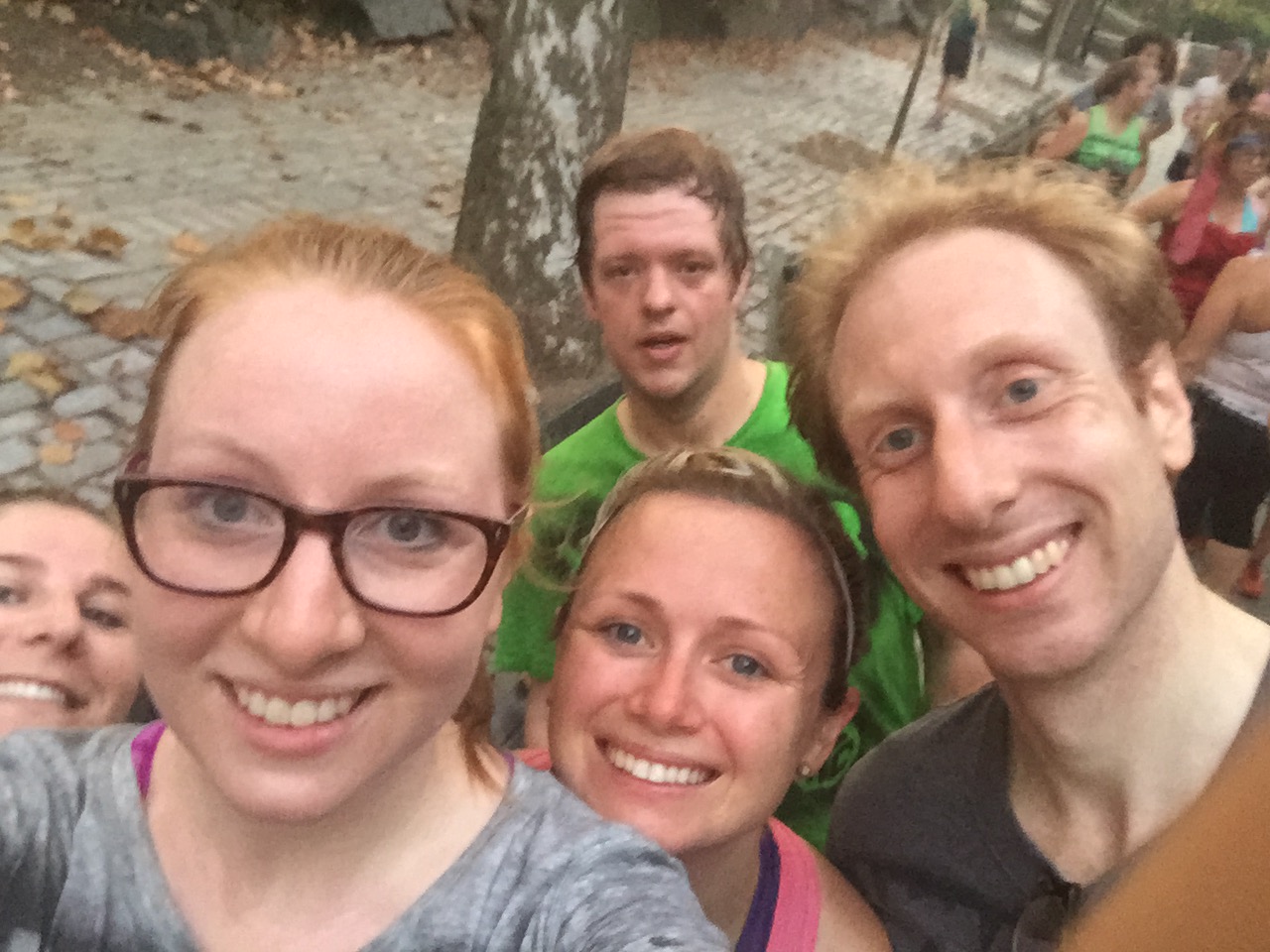
Here are some sweaty pictures of cool people (my sister, cool Sarah, and cool Kimmy . . . or is it Kimi, or Kimmie?!)

November Project

Just a portion of the cool NP_NYC crew!

And then a picture of my sister and me:

November Project

She is better at pictures than me.

As always, happy running, everyone!
Maffetone at Work! Also 9/22/15: Morning Run, 5:30 a.m., 6.2 Miles, Central Park Loop

I’ve written a lot of training run recaps. This morning’s will be short: I ran this morning, and it was lovely. Check out my Training Plan for updates on what I’m up to on a daily basis. I’ll be expanding that page to include the exercises I do at the gym, and welcome any and all feedback on my plan.

Now, for something far more interesting!

I have posted relentlessly about Dr. Phil Maffetone’s 180 Formula for heart rate training, and written about my experience training almost exclusively using this method for almost five months. I have discussed how I PR’d at the Percy Sutton 5k—running a 5:56 per mile pace and besting my previous 5k PR by over a minute—by performing training runs at my maximum aerobic heart rate, and doing (at most) three anaerobic workouts prior to the race. In short, Dr. Maffetone’s method has worked for me. But what about for other people?

Larisa Dannis

Larisa Dannis (reposted from Runner’s World)

Here is a great example from Runner’s World of the Maffetone Method at work. Larisa Dannis, a former recreational runner, ran the USA 50-Mile Road Championship in 5:59:11 in October of 2014, becoming only the third American woman to run 50 miles in under six hours. She will represent the United States in the IAU World 100K Championships in Doha, Qatar in November. She also came in second in the women’s race at the Western States 100-Mile Endurance Run, and was the first female finisher from the mass start at the 2014 Boston Marathon with a time of 2:44:14, only 74 seconds shy of qualifying for the Olympic trials.

How does she train? You can probably guess! From the Runner’s World article: “Dannis trains via the Maffetone Method, doing all of her training runs and races in very specific heart rate zones. It’s an unconventional approach, but one that’s helped her transform herself from a relatively average runner to one of the best American ultrarunners in just a few years.”

The article also discusses her specific heart rate training: “Dannis wears a heart rate monitor to make sure that she’s doing all of her training runs and races in the proper heart rate zone. Over time, she’s learned what heart rate she can sustain for various distances, and uses those numbers to guide her in all of her training and racing. For example, she averaged 134 beats per minute during the Western States this year, and she knows that she needs to be in the 163-165 range during a marathon.”

Finally, “Dannis spent nearly two years building her aerobic base, aiming to not exceed a set heart rate in training. She estimates that she still does more than 90 percent of her training at an easy, aerobic pace.” She has incorporated more speedwork into her routines over time, she says, which also contributed to her excellent finishing time at the 2014 Boston Marathon.

Dannis also employs the piece of the Maffetone puzzle that I am just starting to put together: the nutrition plan. From Runner’s World: “Dannis credits the transformation in her running to three things: training via the Maffetone Method, focusing on whole-body strength (she particularly likes kettlebells), and eating a whole-foods diet high in healthy fats and high-quality protein” (emphasis added).

Such a diet contradicts the common wisdom that runners need to consume a diet high in carbohydrates before, during, and after a race. Anyone who runs road races knows what I’m talking about: carbo-loading for two-three days before a race, sucking down multiple sugar-happy gels during the race, and pounding all sorts of pancakes and other starchy treats after the race as a reward for a job well done. The idea behind the carb-heavy diet is that the body burns lots of sugars while running, so the runner needs to consume lots of sugars to stay properly fueled.

A diet high in healthy fats and protein, however, combined with the maximum aerobic heart rate training advocated by Dr. Maffetone and others, leads the body to burn more fat for fuel. Fat is a more efficient energy source than sugar, and the body creates fewer harmful byproducts at a cellular level when training aerobically and burning fat. This allows faster recovery times, more efficient training, and overall improved health.

At least, that’s the theory. As I do more research, I will expand on this topic. For now, because Dr. Maffetone’s heart rate method has worked for me, I’m willing to explore his guidance on the dietary component of endurance sports. As one running buddy once said after declaring his love for tuna melts, “I sometimes wonder just how good I could be at this sport if I nailed the nutrition component.” Some “food” for thought. Get it?! I’m such a dork.

Finally, I like Dannis’ attitude about racing. She says, “‘Running has always been a very personal endeavor for me. I find satisfaction and excitement through challenging myself rather than competing with others.”

Love it. Focus on improving and running each race better than the last. Results come in many forms.

Happy running, everyone!