Returning to Blogging!

Hard to believe I last posted on December 8! I don’t have a good reason for the delay between posts. Essentially, after the NYRR NYC 60k, I began to reflect on what I want to accomplish with this blog. When I started it in August, I knew that I wanted to write about my running, but had not developed the idea much beyond that. I started by posting about particular training runs I was doing, workouts I attended, and then branched out into race previews and recaps. After a few months, though, I hit a writing wall: What to do next?

Jim NP Cold Running

Getting in some stair running with November Project NYC in December!

That wall, unsurprisingly, coincided with the end of the fall racing season, a season during which I pushed myself and ran my first 10-miler (1:00:20), set PRs in the half marathon (1:20:51) and marathon (2:57:56), and ran my first ultra, the 60k, in under 5 hours (4:55:55), all within less than two months. I knew that my body needed a break; I did not realize my brain did, too. Hence, only a handful of posts since the 60k and now.

All this to say, I’m back! Expect updates concerning my training, but with a more global twist. Expect some posts about nutrition and other fun things I’m up to, such as the Road Runners Club of America coaching certification course that I’m taking in May. And get excited for race previews and recaps for the races I’m planning to run this winter and spring. I might also write more about some of the running books I’ve read lately (more on those below). My goal is to make this blog a spot for people to pick up tips and tricks to achieve their own running goals.
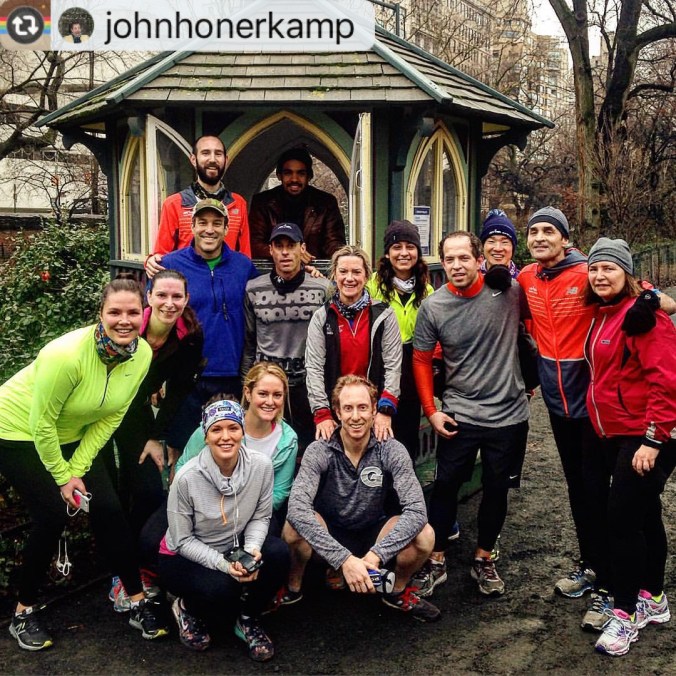
Jim NYRR Virtual Trainer Run

Crushing 10+ miles with NYRR’s virtual training crew!

Thankfully, the time away from hard running and the blog has reenergized me. Regarding training, I began the base building phase of spring marathon training in earnest at the beginning of December, and will likely run the Inaugural Queens Marathon on April 30, 2016. I spent approximately two months running long runs at an aerobic pace, throwing in some strides at the end of the runs, as well as tempo runs (for example, a 5k at 6:00/mile) and progression runs below lactate threshold. I pushed my weekly mileage up from 30 miles to 50-55, and am hoping to increase to 60-65. I’ve also been riding my bike indoors on my bike rollers at least once a week, and hitting the pool (though not as frequently as I would like). In the middle of all that, I ran an unofficial 5k in 17:45 (5:43/mile), and PR’d on the tricky November Project NYC 3.4 mile PR course with a time of 20:36 (6:03/mile). As of yesterday, I ended the aerobic base training phase of my marathon training and began the hill/leg speed phase as per Arthur Lydiard’s basic training scheme. Not bad for two months.

As for the blog and writing about running, I’ve read a bunch of running-related books these past two months. My friend Katherine loaned me “A Race Like No Other” by Liz Robbins (about the 2007 NYC Marathon) and The Oatmeal’s “The Terrible and Wonderful Reasons Why I Run Long Distances.” I also read “2 Hours” by Ed Caesar, a book chronicling professional marathoners’ journey to break the elusive 120-minute marathon barrier (current world record is 2:02:57 run by Dennis Kimetto at the 2014 Berlin Marathon). I also read “Running Ransom Road” by Caleb Daniloff, a powerful story about a recovering alcoholic who sought closure on his past by running marathons and other road races in locations where he was active in his alcoholism.
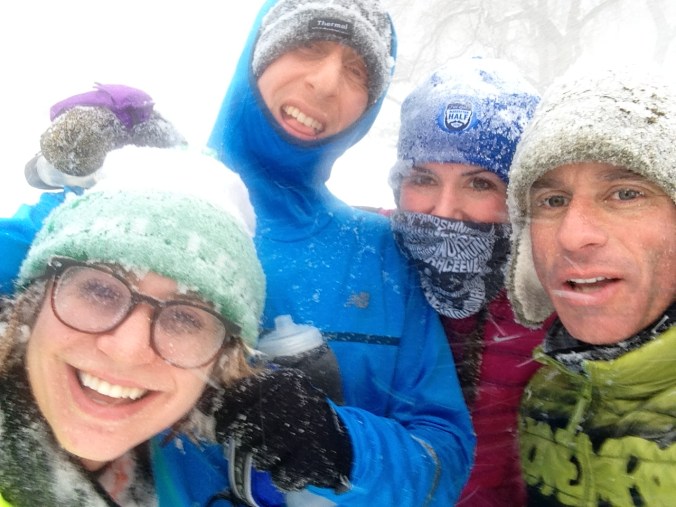
Jim Liysa Laura Ann Raul

Getting in a solid 11.5 miles with Liysa, Laura Ann, and Raul during the blizzard this past weekend!

And finally, I’m almost done with “First You Run, Then You Walk” by Tom Hart, my friend Patrick’s father. “First You Run” is a collection of essays written by Hart, a former high school English teacher, who picked up running at age 31 after he quit smoking. He ran into his 60s, at which time he was diagnosed with lung cancer and had one of his lungs removed, rendering him unable to run continuously for more than a few minutes. His essays discuss a range of topics: running a sub-5 mile, running 37 miles on his 37th birthday, chasing age-group awards as a 60-year-old veteran, and eventually breaking 12 minutes for one mile while running with one lung. What makes the book so amazing, though, is Hart’s meditative writing style and honesty. Every other page I find myself thinking, “Yep, that’s exactly how I think about running.” He gets it.

And in other news, I had a nice Christmas with my family and my girlfriend’s family, was able to travel to Vermont for a few days over the holidays, and have been working and preparing for the spring racing season. Life is good.

Happy running, everyone!
10/30/2015: Morning Workout, November Project, 6:25 a.m., Bethesda Fountain; NYC Marathon Thoughts

I’m going to break this entry into two parts: This morning’s November Project NYC workout, and my random marathon thoughts.

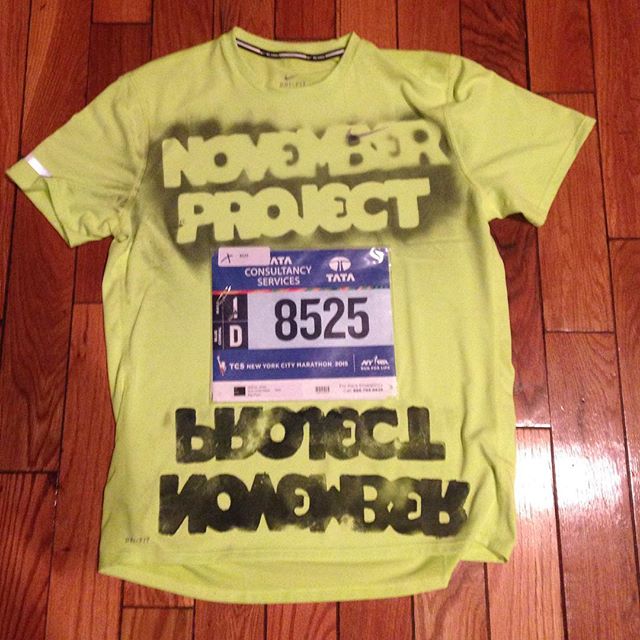
But first! Bib and newly-tagged NYC Marathon shirt! Soon to have my name and (possibly) blog URL tagged on it:

November Project NYC Marathon

Woot! Neon is the way to go!

NP_NYC Workout at Bethesda Fountain

So . . . Paula RadcliffeBart Yasso, Desi Linden, and Dean Karnazes worked out with us this morning. What?! No big deal. Also, Brogan Graham, one of November Project’s co-founders, pounded out burpees, push-ups, dips, lunges, and bear crawls with us because #justshowup and #whatisthis. We also had lots of people in town from other Tribes for the marathon. Just awesome to see so much NP love this morning!

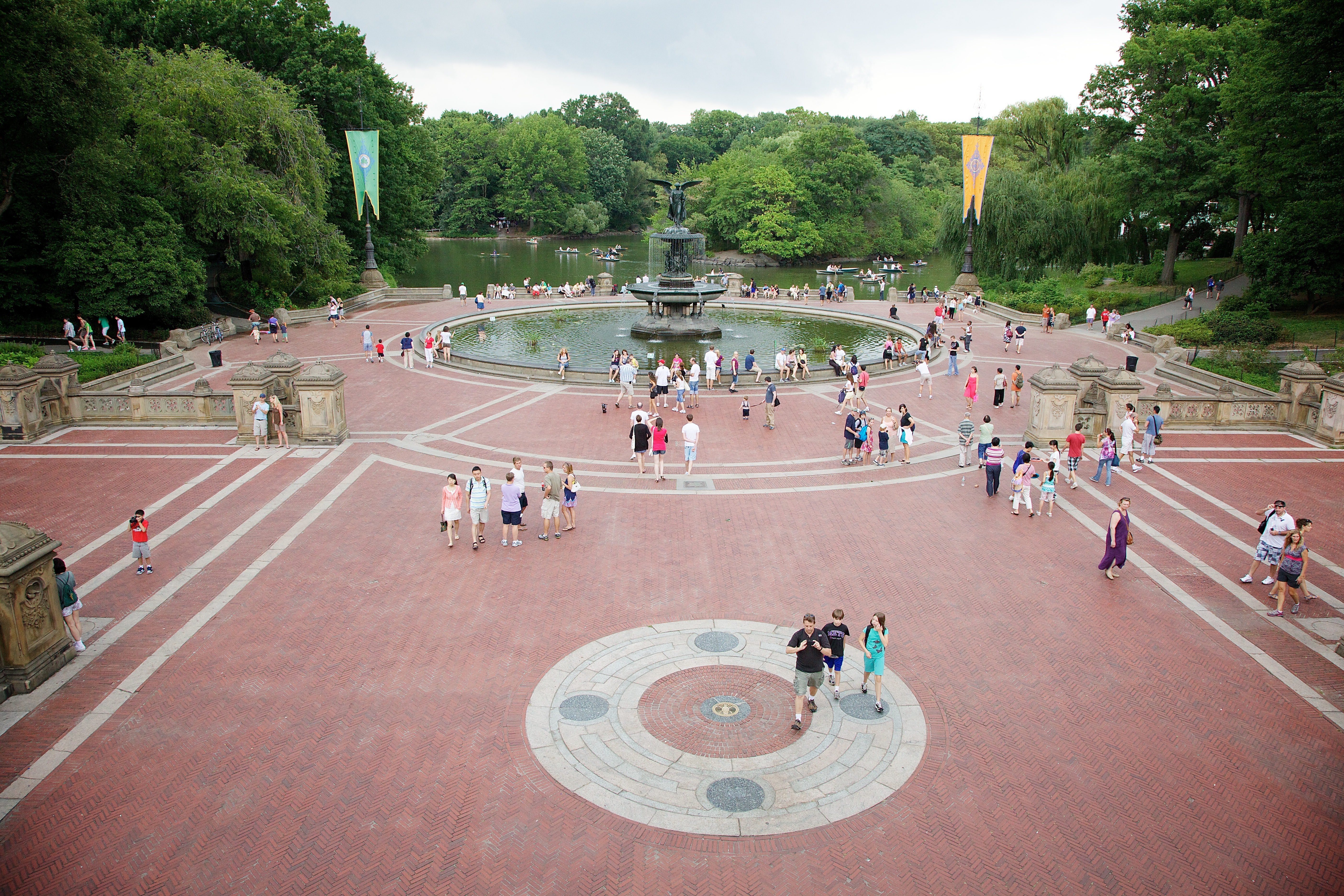
Bethesda Fountain

Bethesda Fountain, much brighter than it was this morning.

The workout consisted of two phases: During phase 1, we broke into two large groups. Both groups began by doing 20 burpees. Then Group 1 lunged through the terrace near Bethesda Fountain in Central Park while Group 2 bear-crawled. At the end of the terrace, everyone ran up a flight of stairs and then bunny-hopped up a second flight. Then everyone did 10 push-ups, 10 dips, and then back to the beginning for more burpees. Repeat for 20 minutes.

Bethesda Fountain Terrace

The gorgeous terrace.

Most of us NYC marathoners took it easy, and I got to do push-ups with Brogan and meet some members of the NYC Tribe that go to the 6:28 a.m. Wednesday workouts (I’m generally a 5:28 a.m. guy). There is something wrong with me when I think that 60 burpees is an easy, pleasant way to start the day.

Phase 2 of the workout was a “burnout.” Essentially, everyone not running the NYC Marathon started at the Fountain end of the terrace, did four or five burpees, and then ran through the terrace, up the stairs, down the stairs, and back to the start. The rest of us lined the terrace and cheered them on. It was wild! Each interval was timed, so if you didn’t make it back to the start in a set time, you joined the cheering squad. We went through seven or eight rounds before the final round, which was just crazy. NP_NYC’s Jason “won” the burnout, with Rob a few steps behind. NP co-founder Brogan also put forth a strong showing, demonstrating the meaning of “leading from the front.”

Marathon Thoughts

I’ve written race previews about my other recent races, but the NYC Marathon needs no introduction. I outlined the course in my pace strategy post, and all of my posts about training have essentially been about training for this race. I believe that, considering my injury which kept me from running between April and June 25, I trained as well as I could, and I am ready to run a solid race.

Of course, doubts have crept into my mind. During my 22-mile long run, I felt the burn in my legs at mile 21. I also did not log tons of miles, peaking at about 50 miles in my peak training week. These two facts could lead me to be concerned that I am not ready to run this marathon as fast as I want.

But poo poo to them! I have to remember these things as well:

  1. During those early weeks of marathon training in July and August, I was still returning to running after injury.
  2. During that return period, with the support of my doctor and physical therapist, I was biking upwards of 100+ miles per week as I prepared for the NYC Century Bike Tour.
  3. Also during the pre-return and return period, all the hours I spent in the pool, which, combined with my time on the bike, helped me build a solid aerobic base on which to begin marathon training.
  4. My solid performances in the Bronx 10-Mile (6:02/mile pace) and Staten Island Half (6:10/mile pace, with a strong sense that I could have run slightly faster if not fearing for my life on the boardwalk).
  5. Maybe most importantly, all of the love and support I have received from my family, friends, girlfriend, NP_NYC, coworkers, and what I might call the Spirit of the Universe, or, in a less spiritual sense, the feeling that I’m not in control of the world, and that my lack of total control is OK with me.

More thoughts to come tomorrow. For now, happy Friday and, if you can (I’m having a hard time), think about something other than the NYC Marathon.

Happy running, everyone!

NYC Marathon Strategy: Two Guides and Thoughts

(Mentally prepare yourself for Jim’s comic overthinking of his race strategy for the NYC Marathon)

If you’ve checked out my Training Plan, you know that I break my running down into weeks, with each week starting on a Monday. As such, I’ve only done one workout this week because I’m tapering for the NYC Marathon on November 1, 2015. Because taper time is slow time, and because I want to keep writing about training and running, and finally because my brain is fixated on the NYC Marathon, I’m going to write about the preparation I’ve done in the time off my feet.

That preparation includes reviewing strategy guides discussing how to pace through the NYC Marathon. I haven’t run a marathon in approximately 11 years. I ran two in college (Ocean Drive in March of 2004 and the Marine Corps Marathon in October of 2004), and did not prepare with any particular plan for either. This time around, however, I have run and trained well, gotten stronger and faster throughout the year, and want to perform well on November 1. Hence, the analysis of race strategies prepared by people who have run the NYC Marathon before.

The first guide I reviewed comes from RunnersConnect. It breaks the race down into five sections: Miles 1-2, Miles 3-15, Miles 16-20, Miles 20-23, and the final 5k. It provides the following pacing suggestions for these sections of the course. I have inserted how these suggestions apply to my goal race pace of 6:30/mile (approximately 2:50 overall):

  1.  Miles 1-2: Go slow! The NYC Marathon begins on the Verrazano Bridge, and the first .8 miles are a steep, steady uphill. Run this mile anywhere from 60-90 seconds over your goal race pace. The final part of Mile 1 plus the entirety of Mile 2 is the downhill portion of the bridge, so run this portion 45-60 seconds faster than your goal race pace, but don’t push yourself too hard (save your energy for the last 10k). Thus, you should finish Mile 2 at about 10 seconds faster than your goal race pace.
    1. For me: I should be hitting Mile 3 at around 13:50 into the race, approximately 50 seconds off my cumulative goal race pace.
  2. Miles 3-15: These miles are mostly flat, so hold back and don’t push too hard through this section. Run these miles at about 10-15 seconds slower than your goal pace, and arrive at the Queensborough Bridge (right after Mile 15) about 60-90 seconds off your goal race pace.
    1. For me: For this stretch, I should be averaging 6:40/mile, which would bring me through Mile 15 in about 1:40.30, about a 6:42/mile pace overall.
  3. Miles 16-20: After the Queensborough Bridge (a tough uphill followed by the inevitable bridge downhill), you emerge on First Avenue, which is mostly downhill on your way to the Bronx. You can make up some time here by running 15-20 seconds faster than your goal race pace.
    1. For me: This brings me to Mile 20 in approximately 2:11:45, approximately a cumulative race pace of 6:35/mile.
  4. Miles 20-23: This section allegedly gets tricky because it involves two bridges and thin crowds. Running 20-30 seconds over goal race pace is OK here.
    1. For me: If I run this section in 20:30 (6:50/mile), I will hit the last 5k at 2:32.
  5. The last 5k: This includes the uphill on Fifth Avenue before the Park, and then the up and down run through the Park, across Central Park South, and then to the finish in the Park. If you’ve followed the strategy, you will apparently be able to run hard through this section, fighting through pain. The strategy guide provides no pace, but I imagine the idea is “as hard as you can still manage.”
    1. For me: If I can push hard, I’ll come through around 2:50, though maybe a couple of minutes behind.

Running and the City also provides an NYC Marathon strategy guide full of useful information about pre-race preparations, how to handle the athlete’s village before the race, and some anecdotal insights about why it’s important to run the first half of the Marathon slower than you might think. She breaks the race down into more distinct parts than Runners Connect does. Here are her pacing strategies:

  1.  Miles 1-2: Run Mile 1 at about 1:30 slower than your goal race pace, and Mile 2 at about 20 seconds faster than goal race pace, bringing you into Brooklyn approximately one minute off your cumulative goal race pace.
    1. For me: I’ll enter Brooklyn at 14:10 into the race.
  2. Miles 3-15: Here, the stated goal is to arrive at the Queensborough Bridge feeling fresh and ready to go. You should run this section of the course at 5-10 seconds faster than your goal race pace. So, overall, this means that by the Queensborough Bridge, I should either be right at my goal pace or slightly ahead of it.
    1. For me: Running at a 6:25/mile pace, I would hit the Queensborough Bridge in approximately 1:36.50, slightly faster than under the RunnersConnect plan.
  3. Mile 16: The run across the Queensborough Bridge can feel tough, with no crowd and a steady uphill, so keep the effort constant while dropping pace to about 20 seconds slower than goal race pace.
  4. Miles 17-19: Here, she breaks it down as follows: Mile 17 at 30 seconds below goal race pace, Mile 18 at 10 seconds over, and Mile 19 at goal race pace.
    1. For me: I should average 6:30/mile for Miles 16-19, coming through at approximately 2:02.30
  5. Miles 20-23: The goal here is to stay at or 5 seconds below goal race pace, despite the bridges.
    1. For me: Averaging 6:25/mile for Miles 20-23 brings me to the Fifth Avenue hill in approximately 2:28.25.
  6. Mile 24: This mile includes the hill on Fifth Avenue, a hill many people have told me “comes out of nowhere and zaps your energy.” RaTC recommends a pace about 20-30 seconds slower than goal race pace.
  7. Miles 25-26.2: Mile 25 has a lot of downhill with some rolling uphill. Try to run it slightly under goal race pace (5 seconds or so). Mile 26 includes the uphill across Central Park South, which might put you at 5 seconds over goal race pace. The final .2 is the steepest uphill of the race, so plan to run it about 20-30 seconds slower than goal race pace.
    1. For me: If I were to follow this plan completely, I would cross the finish line in almost exactly 2:50.

As I’ve never run the NYC Marathon before, these suggestions sound great. I like that they advocate different approaches to the race: It reminds me that I ultimately have to listen to my body and adjust as I progress, and don’t fret if things don’t go my way. Despair invites the fastest path to a poor time.

However, both plans advocate running the first half even slower than you think necessary. The second half of the NYC Marathon is, I’ve heard, deceptively hilly, so every extra gram of glycogen you don’t burn on the first half pays dividends during the second. Both plans also discuss the adrenaline surge that the crowds inject into your running, and implore you to stay within yourself and your pace throughout the race. Ultimately, the goal is to conserve your energy while running a smooth race until the last 10k, when your body starts to feel the depletion of its glycogen and begins to break down.

Today, I’m resting my body. My left foot has a slight pain, so I’m going to let it chill even though I’d love to do a slow run around the Park. I’d rather be physically healthy on race day and slightly less fit than nervous about injuring myself and slightly more fit.

How’re you prepping your race strategy?

Happy running, everyone!