Prologue: I’m finishing this recap approximately 72 hours after running 37.2 miles – farther than I’ve ever run. My legs feel great, with limited soreness in my right quad and left calf. My left knee, which felt like someone took a baseball to it yesterday, feels much better after two days of IT foam rolling (to alleviate any potential IT band syndrome), ice, and ibuprofen. My left ankle, which hurt for a week and a half after the NYC Marathon, feels 100%, in large part due to my constant ankle stretching these past three days. I’m ready to run again!
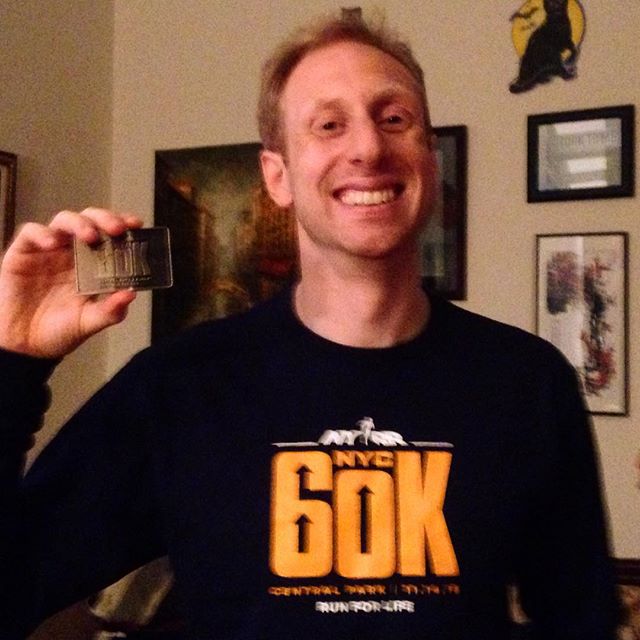
Looking good! Feeling the burn in my legs!
But I won’t . . . at least, for a week, and possibly two. My body has taken a serious beating this past month and a half, running hard at the Bronx 10-Mile, NP_NYC PR Day, Staten Island Half, NYC Marathon, and NYRR NYC 60k, and it craves a break from the pounding impact. Time to hit the bike, the pool, and prepare for the next training cycle by maintaining my aerobic fitness.
Finally, I have felt slightly sick since the 60k ended. I’m not feverish or nauseous, but have had a low-grade headache and feel constantly dehydrated. I’m not sure if the nine GU gels I consumed during the race have anything to do with this, or just that I put my body through more stress than it’s ever handled before. Either way, I’m going to continue drinking water and taking it easy.
Now, the recap before the recap: I ran the NYRR NYC 60k (37.2 miles), my first ultra marathon, this past Saturday in a time of 4:55:55 (7:57/Mile), good enough to snag 16th place out of 353 finishers. I am very pumped about finishing my first ultra in one piece, maintaining a solid pace throughout, and learned a lot about self-inflicted pain and how to keep moving forward.
The recap: The morning before the 60k, I prepped my race clothes and food bag. My race outfit included shorts, my November Project NYC t-shirt, my NYC Marathon long-sleeved shirt, a wool hat, running gloves, and socks. For food, I prepped 10 GU gels, two bananas, two water bottles, and three bags of pretzels (each bag assembled by taking about a serving of pretzels from a larger bag and transferring them to a plastic sandwich bag). I also purchased and decarbonated a 20-ounce Coca Cola by opening the bottle and pouring the soda into a large plastic container, and then pouring it back and forth between plastic containers for about five minutes. I lost about 4 ounces of soda because I am uncoordinated. The morning of the race, I also made a peanut butter sandwich with sourdough bread, but never got around to eating it after the race.
For dinner the night before, Melissa and I got sushi with her college friend. I had chirashi, which is just sashimi with rice on the side. I also had some tiramisu after dinner, which tasted great and (Jim will now rationalize) added to my pre-race carb-loading. I was able to get to sleep around 11 p.m.
The morning of the race, I woke up at 6:15 a.m., ate my standard pre-race breakfast of non-fat Greek yogurt with agave, two bananas, and two pieces of sourdough toast, one covered in peanut butter. I drank some water, piled on my race outfit, threw on a coat, and headed out the door. The morning air was chilly but not frigid, and my body warmed up as I walked the mile from my apartment to the NYRR house at 9 East 89th Street to pick up my bib.
Unlike the NYC Marathon (with its 50,000+ runners and days of expos), between 300 and 400 runners attempt the 60k. Therefore, NYRR allows bib pickup only the morning of the race. I met up with Steve from NP_NYC at the NYRR house, and we loaded our food into the clear bags provided by NYRR, and our other extras into a separate clear bag. Steve has done numerous ultras, including winning a 100k on Long Island last month, so I like to think of him as my ultra spirit guide. His food bag contained Halloween candy and Gatorade. He chuckled at my bananas and pretzels, and we talked race strategy a bit. Like me, Steve wanted to run sub-5, so we both talked about maintaining around a 8:00/Mile pace.
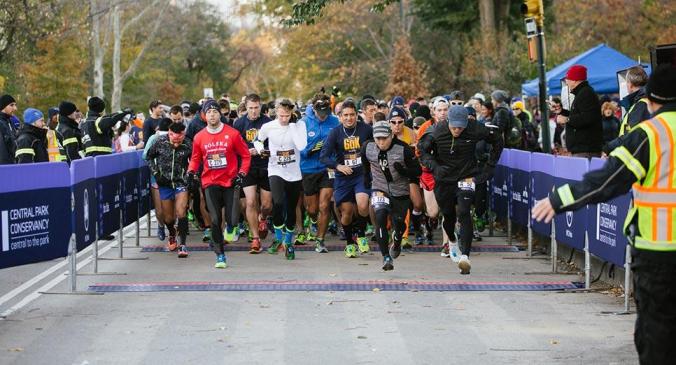
Further distancing itself (pun intended) from the NYC Marathon, the 60k is about as stripped-down a race that NYRR offers. NYRR partitions off a starting line with electronic scoring mats, but that’s all it partitions: Central Park remains open, and runners and walkers can hop into the running lanes at will. The food bag drop was just the benches near the start line: While an NYRR volunteer watched over the bags, our bags didn’t even have our numbers on them. The only clock on the course was at the start line, and the course had no mile markers. Scoring was performed manually with no live tracking element. Whenever a runner crossed the start line, a volunteer would yell out the runner’s bib number, and the scorer’s tent (about 10 people) would input the data into their system. An electronic board would then update, indicating how many laps the runner had completed, and how many he had left. Unlike other NYRR events, there was no singing of the National Anthem, no public address announcer, no music, no real PA system to speak of, and a severely reduced crowd. This, my friends, is as close as I’ve been to running purism in NYC since I started running again in 2014. It was kinda great.

NYRR flying the French flag at the starting line in solidarity with the recent terrorist attacks in Paris (repost from NYRR.org).
Before the race began, I hung out with my buddy Sam, Steve, and some other folks. All of us had done the NYC Marathon two weeks earlier. I ditched my gloves in my food bag, ate my first gel, put two additional gels in my shorts pocket, and lined up at the front of the non-existent corral. We had a moment of silence for Paris, abbreviated instructions, and then the air horn signaled the start of the race.
And we were . . . off . . . jogging . . . at a comfortable 8:00/Mile pace . . . and inexplicably close to the front of the pack. Ultras are a different beast!
I ran the first two miles with Steve and Sam, taking in the cool air and blue skies. Sam and I talked while Steve listened to music, and we watched the leaders form a pack and build some distance on us. Once mile 3 began, I started to pull away from Sam and Steve, and by the time I got to Mile 4 I was running with completely new people, all running at steady paces and seemingly enjoying the fact that we were out on a Saturday for an extended run. I made it up Cat Hill without any trouble, cruised through the straightaway to the starting line at Engineer’s Gate, grabbed a cup of water, took my second gel, and told myself, “This is lap 2 of 9. You got this.”
I began to formulate a race plan as I began lap 2. I figured that I would run at a 7:45/Mile pace until the beginning of lap 6, and then figure out whether to run harder, maintain my pace, or slow down. I enjoyed the solitude of the race, but also loved the unofficial cheer stations at the east side of the 102nd Street transverse, west and east sides of the 72nd Street transverse, the group from The Most Informal Running Club Ever on the grass near the Met, and Alison from Harlem Run hanging out near the west side water station, tossing out high fives every loop.
I stopped briefly after the second loop to grab a banana from my food bag, downed another gel and some water, and ran while eating my banana. Loops 3 and 4 passed without much thought: I maintained my 7:45/Mile pace, began to loop some of the slower runners, took off my long-sleeved shirt, and smiled as I high-fived the same folks at different points on the course. I grabbed two water cups at each aid station and chatted with fellow runners. I took a gel each time I crossed the starting line. I ate a second banana when crossing the starting line after loop 4. I threw my hands up and smiled when I saw Katherine from NP_NYC. I felt strong.
A quick note: At this point, the race becomes a blur. The constant looping and friends moving around the course and my own crazy fuel-depleted brain . . . I don’t remember where or when I saw people. What follows is an approximation of how the final five loops went down.
The leaders and eventual winner looped me about halfway through my fifth loop. These runners were the first to pass me since the beginning of the race. The group of two must have been running around 6:30/Mile pace, which was frustrating to watch because I knew that I could run that fast, but definitely not for 37.2 miles. I sighed and kept my pace steady, beginning to feel my hips, quads, and hamstrings getting slightly heavier. No worries, I thought. After 19 miles, whose leg muscles wouldn’t be tiring? At some point in this section of the race, I saw Ali from NP_NYC near the food bags. She asked if I needed anything. I felt slightly off balance and almost fell over, but said no, slapped a high five and pounded the pavement.
I picked up the pace slightly on loop 6 after grabbing a bag of pretzels and taking a gel. My legs slowly felt heavier, but I smiled and slapped high fives with Raul from NP_NYC, and then Myles, and then Chris Mosier. I started to focus more closely on the immediate tasks at hand: one foot in front of the other, breathe, keep the pace steady, easy on the uphills, harder on the downhills. My average pace accelerated to 7:43/Mile. My legs got heavier. I pounded onward.
When loop 7 began, I knew that I could not accelerate my pace and still finish under five hours. My legs, while still functioning, felt like the calm before the hurricane. I smiled less at the people cheering. I grimly acknowledged about halfway through the loop that I was now running farther than I’d ever run before. Every step now brought with it a question: Why was I doing this? I could stop and the pain would end. But I fought on, pushing on the uphills and finding the downhills much less satisfying and slower.
At random points I began talking to myself, saying, “You got this. You got this thing, Jim. Just keep going.” I used the high fives from Alison and her newly assembled NP_NYC cheering crew to push me a little farther. I focused on the backs of the slower runners and reeled them in, passing them one by one. I let out a few primal screams to remind myself that I could do this. I surged every couple of minutes, reinvigorating my legs.
By the end of the loop 7, I was in the zone. Melissa had come out to see me finish, and she spotted me as she and I were ascending Cat Hill at the same time. She said hi! All I could muster was, “I have one more loop. Woot!” No “Hello!” No “Thanks for coming!” In the zone. I was going to finish this thing, and I was sticking with my pace. George from NP_NYC offered me some juice and ran with me for a few seconds near the end of the loop. All I could muster with him was, “I feel terrible.” In the zone. I just kept going.
Before loop 8 I took a gel and grabbed my decarbonated Coke. I slammed some water and headed back onto the course, taking large sips of the Coke as I pushed through even more pain. Once I finished the Coke on the 102nd Street transverse, I felt my legs click into gear again. Woot! I pushed the pace slightly, only to feel the legs get heavy again. I kept moving forward. I grabbed high fives when I could, smiled as well as I could, grabbed my two waters on the west side, told myself that I only had to run Cat Hill two more times, and kept moving forward.
Boom! Last loop coming. I high-fived everyone I knew and said, “Last loop, baby! This is it!” I got a lot of surprised looks, either because people couldn’t believe I’d already run 33 miles, or because I looked like a madman possessed. I ate my final gel, pounded water, and pushed the pace as hard as I could. I slowed on the west side between miles 34 and 35, and a runner that I’d passed on loop 3 sped past me with a smile and an encouraging word. Another runner passed me looking strong and belting hip hop lyrics. I doubled down, pushed hard up Cat Hill, picked up some high fives on the straightaway near the Met, and did my version of a sprint (imagine me running with another person strapped to my back) and crossed the finish line, arms up and smile wide.
Steve from NP_NYC rolled through the finish line looking strong in a sub-5 time. He was ready to keep running. Based on his Strava, I think he ran 11 miles the next day. What a nut. I love this guy!
I literally could not walk home, so Melissa hailed a cab outside Engineer’s Gate. Once home we ordered a pizza, of which I ate six of the eight slices. We watched movies and I barely moved for the rest of the day. Thank you, Melissa, for being understanding!
I might do a separate “lesons learned” post about my ultra experience, but for now I will say this: Everyone who says that the biggest enemy in an ultra is you is absolutely correct. My brain wanted me to stop so many times, yet my body was capable of moving forward. Relentless forward motion. In the zone.
I will also say this: Muscle endurance (basically, the amount of time your muscles can function without getting tired) is huge for ultras. My aerobic fitness was solid for this distance; my muscle fitness was not quite up to par. And that’s fine! I didn’t do any specific ultra training. In the future, though, more time in the gym to work the glutes, hips, and hamstrings, plus time on my feet running longer distances will be key to improving finishing times.
All that aside, I was so happy to finish, to finish in the top 5% of runners in the race, and for all the support from Melissa, my NP_NYC buddies, and my family, who either think I’m awesome for my endurance running, or insane. There is no middle ground.
Here’s my Strava for the race. I accidentally paused it around mile 29, so I’m missing three miles. Either way, you can see that my pace slowed toward the end, but not by much! And that last .2? I forgot to stop the timer until a couple minutes after I finished.
Happy running, everyone!



 Time on My Feet