12/8/15: Morning Run: 5:50 a.m., 7 Miles: Myles and Londoners

Good morning! I’m in week 2 of aerobic base-building for winter and spring races. I logged just over 33 miles during week 1, most done at a moderate, aerobic pace. My aerobic fitness, as determined by the MAF test I performed yesterday, seems strong, but I’m hoping to improve it a bit before I really pick up the pace this spring.

Of course, despite knowing the importance of keeping the pace easy during a base-building period, I sometimes get carried away. I’ve read warnings from some coaches that any anaerobic running during a base phase can jeopardize a runner’s aerobic fitness. I’ve also read plenty of guides that encourage fast running at all stages of training. Ultimately, however, the occasional hard run, performed whenever in my training, has not had a negative effect on my overall fitness and speed. So, while I will perform most of my runs at an aerobic pace for the next two months, I’m fine with occasionally picking up the pace, and can justify it by working on leg speed and negative splits.

This morning, I happened to find myself in some faster-paced circumstances. I hit the Central Park loop about 20 minutes behind schedule. While I was warming up, Myles, leader of the NP_NYC running team, flew past me. I actually recognized his footfalls before seeing him: He runs with an ideal high cadence and lands softly. I called out his name, and we ran about one and a half miles together, talking about our uber-competitive natures and the upcoming Ted Corbitt 15k. If you don’t know who Ted Corbitt is, you need to read this article. In addition to representing the United States at the 1952 Olympics in the marathon, he essentially introduced the ultramarathon to America. He ran well into his 80s, and at his peak he ran approximately 200 miles a week. He was also the first president of New York Road Runners. Fred Lebow, the founder of the New York City Marathon, called Corbitt “the father of American Distance running.”

Anyway, after Myles peeled off at Engineer’s Gate, I kept on rolling at the same pace, slightly faster than my normal moderate run. Everything felt good as I cruised up Harlem Hill, easing up so as not to spike my heart rate. About halfway up the hill, a guy with grayish hair, blue shirt and black running pants blew past me. I checked my heart rate: 138. Way too slow! I picked up the pace, shortened my stride on the downhill, and kept a steady state over the next two mini hills. The other guy kept a solid pace, but I slowly crept closer to him. As we descended the second mini hill, I came even with him.

“This is quite an effort for six in the morning, ain’t it?” He joked in his British accent.

I agreed, and we ran together for a bit. He was in town for business, and had gotten up to run because, for him, it was basically 11:30 a.m. and he couldn’t sleep anymore. He was getting in a training run for a Boxing Day race, which, in my opinion, isn’t a real holiday (note: I know I know, it totally is . . . no offense, Rest of the World). We picked up the pace down the final mini hill, and cruised along past the Lake near 75th Street.

“How much farther is it to Columbus Circle?” He asked me.

“About three-quarters of a mile,” I replied.

“OK. I’m gonna give it a bit of a sprint the rest of the way, then,” he said, and he picked up his pace enough that I noticed my breathing change. I understood his implicit challenge, and kept stride with him.

I said I’d run with him until we got to my exit at 72nd Street, but quickly decided to push it all the way to Columbus Circle. He smiled and said, “Good!” We pounded the pavement and continuously ran faster. I breathed harder and turned my legs over faster than him (he had a slow cadence). We passed the finish line area of the NYC Marathon, and I pointed it out. He grunted in agreement. We were in the zone.

Just a quarter mile left to the Columbus Circle exit. I pushed the pace. He followed. I pushed a little harder. He pulled slightly in front of me. I got on my toes and dug in, pushing hard but not quite all out. He maintained. I dug in harder. He relented, and I finished up about four seconds before he did.

I never got his name, but we shook hands, and I wished him a good trip and good luck on Boxing Day. He smiled. We each took a moment to catch our breath, and then I jogged home.

Most runs aren’t that exciting, or that random, but I’m glad when they happen. And that impromptu race at the end? I truly believe it’s not about who finishes first, but rather about the spirit of competition, and accepting challenges as they come. I might be shaking my head if he beat me, but I know I would have had just as much fun.

Anyone else have stories of making random friends/competitors during a routine training run?

Happy running, everyone!

Race Preview: The NYRR NYC 60k, November 14, 2015

I ran the NYC Marathon just under two weeks ago. I took six days off from running to allow a sore ankle to heal. I took it easy for the past six days, running about 16 miles since Sunday. I stretched, worked my core, and nailed my nutrition plan by eating all the leftover Halloween candy and pie of which a boy could ever dream. Essentially, I followed the runner’s plan in some ways, and completely disregarded it in others.

Despite all that, I will run the NYRR NYC 60k, my first ultra marathon, tomorrow! I first found the 60k around the time I was accepted in the lottery for the NYC Marathon. At that time I was reading Born to Run and all amped up about ultra marathons. I kept it in the back of my head throughout the year, and decided to add it to my schedule over the summer.

While I was injured and on crutches in April, May, and part of June, I doubted whether I could train for this race on only four months of training (July-October), with July being a slow return to running. After reading numerous recaps of the race, however, and realizing that many people ran and finished it after the NYC Marathon on marathon training only, and reading further that people training for a 50k often train based on a marathon training plan, I realized that I could enter the race on my limited training and treat it as an opportunity to learn about ultra running.

And here we are.

The race follows a very straightforward course in Central Park:

  • Beginning at Engineer’s Gate (90th Street and Fifth Avenue), run a 5.2-mile lower loop of the Park (no Harlem Hill)
  • Upon returning to Engineer’s Gate, run eight inner loops (four miles each)
  • Collapse, arise victorious, eat all the food known to man, collapse from insulin shock, arise beaten but not broken

The race also carries limited fanfare: no professional photographers, no live tracking (the race is manually scored by an NYRR worker checking off how many loops you’ve run whenever you cross the starting line), and a much more lax participation policy: anyone can hop in and run a loop or four with you. Friends, who wants to keep me company/sane?

Further, NYRR allows us runners to bring a clear plastic bag filled with liquids and foods of our choice, to be placed on a “nutrition table” at the starting line and filled with whatever food we want.

Sounds easy, right? You get your own food and all the friends you could ever want supporting you. Here’s what’s going to make this run a beast (besides the 37.2 mile aspect of it):

  • Nine cat hills. Yes, we get to run Cat Hill (3.3% gradient, .25 miles) nine times. As my friend Sam joked, “By the end, it’ll feel like Cat Mountain.” For real.
  • While Cat Hill complicates the east side of the Park, the cluster of three rolling hills that I call the lesser Harlem hills dominates the northwestern corner of the loops. None of these hills are particularly long or steep. However, the constant up and down could affect pacing. Because I’ve trained in Central Park on these hills many times, and in training I tend to run the hills slowly so as to keep my heart rate down, I think I have an advantage here, and will run as if training.
  • Nutrition nutrition nutrition. Having never run an ultra before, I have limited knowledge about how to fuel properly for the race. A friend told me to employ my marathon fueling strategy over the 37.2 miles, make sure to drink a lot of water, and to recognize that most people experience some kind of wall around miles 29-30. He recommended bringing a decarbonated Coke to slam back at this point in the race.
  • So, based on my marathon nutrition and my friend’s advice, here’s what I’m going to bring to the race:
    1. 10 GU gels with sodium and caffeine
    2. Smaller bags of pretzels for extra sodium and carbs (I’ve eaten them in training run before, and they don’t hurt my stomach)
    3. Extra water bottles
    4. Bananas
    5. One 20-ounce decarbonated Coke
    6. Faith, hope, and love

Even though I’m going into this race at less-than-top shape (you know, having run a marathon less than two weeks ago), I have two basic goals: 1) to finish; and 2) if possible, to break five hours (an 8:00/Mile pace gets you 4:57ish). I will try to settle into a rhythm and see how I feel around the marathon point. If I’m dying, I’m happy to adjust and focus on finishing. If I’m still going strong, giddyup.

Ultimately, though, the goal is to finish so that I can earn the right to wear this year’s race bling:

NYRR 60k

Awww yeahhh

And seriously, who wouldn’t want such a handsome belt buckle?

I might not sound like it, but I am PUMPED about this race. I’m currently trying to figure out if I want to run a 50-miler next year, so this race will help me sort out 2016’s running goals. It also seems like it’ll be fun to run with friends as I attempt to go farther than I’ve ever gone before. And also, why not? If 300 other folks (about how many who finished last year) are attempting something awesome less than a mile from my apartment, why would I stay in bed?

Happy running, everyone!

11/11/2015: Morning Workout, 5:28 a.m. and 6:28 a.m., November Project: Double Trouble

Happy Veterans Day! Here’s to all our veterans who dedicated their lives to protect the freedom we so often take for granted. Without them, we might not enjoy our lives the way we do. Thank you!

Happy Veterans Day!

Onto the running!

I hit both November Project – NYC workouts this morning for a double dose of running. Here’s what we did:

  1. Starting from atop the walkway at Carl Schurz Park, run north toward the Mayor’s house.
  2. Do four “Good Morning, Mr. Mayor!” burpees outside the Mayor’s house, saying one word during the hand clap portion of the burpee, ultimately saying GGMM by the final burpee.
  3. Complete the loop to the top of the walkway.
  4. Do 10 pushups.
  5. Run a loop in the opposite direction.
  6. Lunges across the starting point.
  7. Repeat for 35 minutes.

This workout was very straightforward and not too difficult (at least the first time around). Overall, I ran about seven miles and did close to 40 burpees, 80 pushups, and a bunch of lunges. I got to run with Paul, one of the co-founders of NP_NYC, and we talked about post-marathon weight gain (inevitable and the last thing we should be worried about) and future running goals. I also got to run with my sister. My ankle, which had been bothering me post-marathon, felt good but not 100% recovered, although it was pain-free during the running.

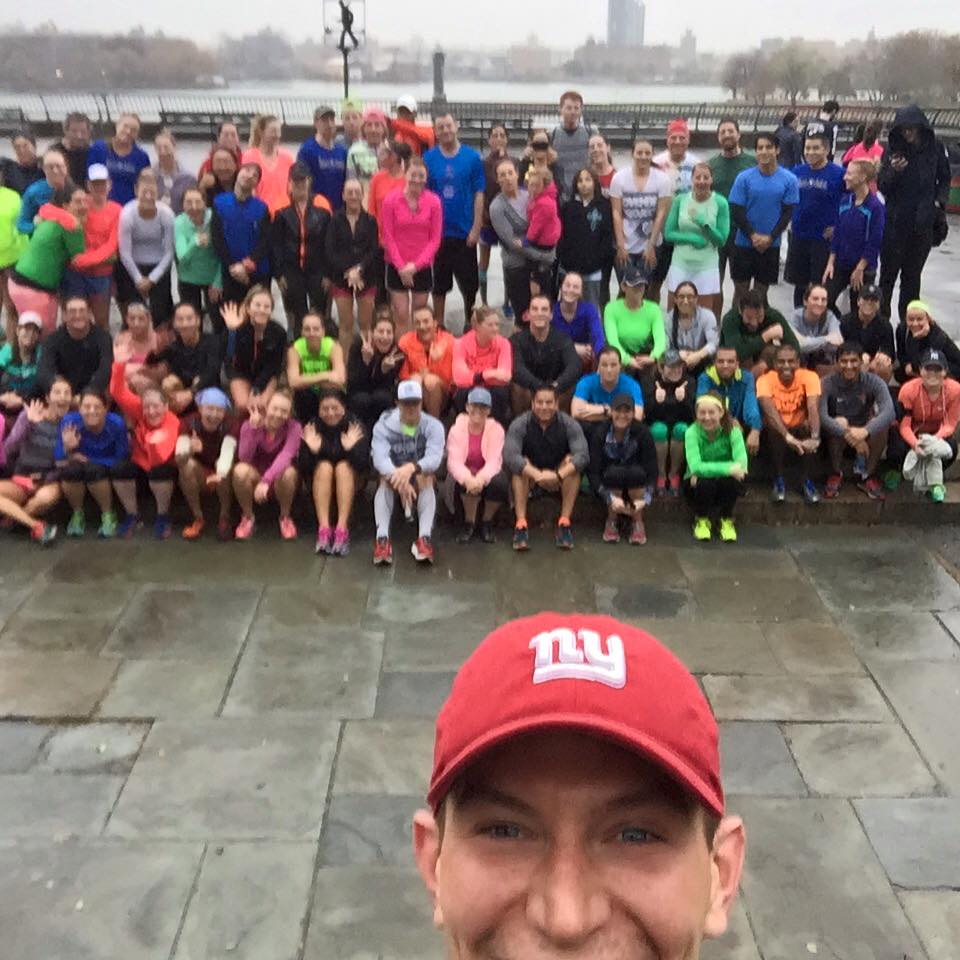
The big news from this morning was that Steve Weatherford, former kicker for the New York Giants, came to the 6:28 a.m. workout. He ran with us, worked out with us, and seemed like a genuinely nice dude. He posted this picture on social media:

Steve Weatherford

Steve Weatherford, former kicker for the NY Giants, at NP_NYC this morning! (repost from Facebook)

In other news, while I’m scheduled to run the NYRR 60k this Saturday, I’m still playing it day-by-day because of my ankle. I’m leaning toward running because I do feel strong for the most part, and in small part because instead of medals, NYRR is awarding belt buckles to finishers (similar to the finishers’ bling at other ultra endurance events), and who doesn’t want a sweet belt buckle for completing a race?

NYRR 60k

Look at that race bling! (repost from Facebook)

Happy running, everyone!